On Thursday Lebanon is celebrating the sixth anniversary of liberation from Israeli occupation of most of its southern territory. Despite the monumental political and military achievement that such liberation represents, residents of southern Lebanon had little to celebrate about in terms of economic development since the historic date in 2000.
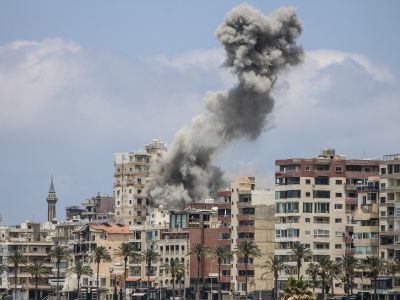
Before the withdrawal, clashes between Israel and Hizbullah have resulted in enormous damage to infrastructure and services in the region, as well as to agriculture, industry and housing. As a result of such devastation to the local economy, a steady wave of emigration has ensued.
Following Israel's withdrawal, the Lebanese government declared an ambitious five-year development plan for southern Lebanon, totaling some 1200 million LBP, to be distributed as follows: 896 million LBP for basic infrastructure and services, 103.4 million LBP for socio-economic development, 191.3 million LBP for victim assistance and 8.6 million LBP for mine clearance projects.
Despite such promises, however, there has been little investment in southern Lebanon since the Israeli pullout. A donors' conference for the south, promised in October 2000, has also yet to take place.
Experts attribute the fact that only a fraction of the required rebuilding funds have been deployed to several factors, including lack of government planning and political conditions often imposed by would-be donors.
Many observers claim that lack of investment is directly connected to the presence in the area of Hizbullah, which currently controls the southern portion of the country. Credited with the expulsion of Israeli forces, the Shiite movement’s conflict with Israel and calls by the US for its disarmament have apparently deterred would-be donors from investing in the south.
As a result of such underinvestment, some 40 percent of households in the south live today without basic needs, including viable sanitation systems and access to potable water.
Residents also suffer from extremely poor access to education. While schools exist in each of the region's villages, many lack even the most basic equipment, such as desks and school supplies.
Unemployment in the area, too, is widespread; the rate of residents without work is currently believed to be some 20 percent. Historically, residents of the area have been farmers, with traditional crops consisting of olives, grapes, figs, pomegranates, wheat and tobacco. With the coming of the Israeli occupation, however, much of the area’s arable land was littered with mines, limiting agricultural opportunities. Consequently, this too has led to a substantial outflow of the local work force. All these troubles led to growing crime in the area, migration to the north or abroad and to a general loss of hope by local residents.
As things stand now, only a mere conceptual change within the Lebanese government could translate into a significant push for southern Lebanon's economic development. Such a change should clarify to Hizbullah that it is more important at this stage to take care for the daily economic needs of local residents, rather than viewing the area solely as a missile launching pad into Israel. Furthermore, experts agree that so long as Hizbullah maintains its current military presence in the area, foreign investors are likely to avoid investing in the region's development.