


Shortly after the first reveal of a bronze statue featuring a historic figure on the southwestern town of Sapri, several Italian politicians, mostly women, started calls for its removal, citing "sexist" artwork.
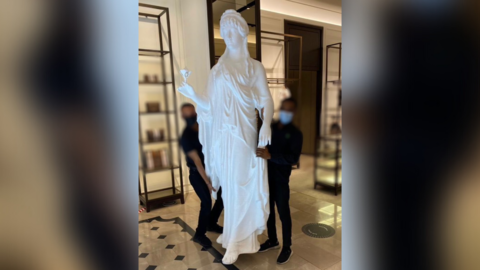
'Astounded' artist Emanuele Stifano [sic] says he 'took advantage of a sea breeze that gave movement to the long dress, and as a result put in evidence the body ...' https://t.co/vH7YbSjoUC
— sebastian o'kelly (@sebastianokelly) September 27, 2021
The statue, created by Salerno-based artist Emanuele Stifano, pays tribute to Sapri's Spigolatrice, often referred to as the Gleaner of Sapri. Sapri was a poet that aided the 19th-century revolutionary activist Carlo Pisacane during his failed attempt to dethrone the King of Naples in 1857. The attempted revolution resulted in the killing of over 300 people, according to historic records.
Yet, the statue stirred many protests by feminist voices who questioned the transparent dress of the statue, saying that they object to "the continuous sexualizing of women including historic figures."
Her name is “Spigolatrice di Sapri”. It is a Luigi Mercantini’s poetry that talks about the Pisacane’s dispatch in which 300 young man died. They were fighting agains their King ( Regno delle due Sicilia ) to create Italy as a united country.
— Edoardo Venturini (@edoventu97) September 28, 2021

The Independent reported a group of female politicians who stated that "Once again, we have to suffer the humiliation of seeing ourselves represented in the form of a sexualized body, devoid of soul and without any connection to the social and political issues of the story."
Translation: "I'm shocked and displeased by what I'm reading. I have been accused of all kinds of things that have nothing to do with my personality and history. When I make a sculpture I always tend to cover the human body as little as possible, regardless of gender. In this case, since the statue is placed by the seafront, I ′′ took advantage ′′ of the sea breeze that moves the long skirt, to highlight the body."
In response, Emanuele Stifano took to Facebook to express his shock at the public reaction, saying that his style of art has always been minimizing coverage of human bodies regardless of sex, because "he is a lover of the human body."


