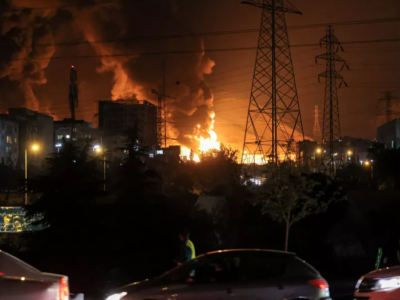
An Israeli drone crashed over southern Lebanon Sunday evening, amid mounting tensions between Israel and Hezbollah following a deadly Israeli airstrike in Syria earlier this week.
There is no indication yet if it was brought down deliberately, although the Israeli army stressed in a statement that there was “no chance of information leakage” from the crash site.
Israel's Channel 12 reported that the drone crashed after it experienced a technical failure.
Israeli Prime Minister Benjamin Netanyahu declared earlier Sunday that Lebanon was responsible for any attack on Israel conducted from within its territory, alluding to intelligence that Hezbollah may be planning an upcoming operation.
Netanyahu took to Twitter to declare that the Lebanese state was itself “responsible for any attack against Israel,” and that Israel would “not allow Iran to establish a military base” on its northern border.
This comes less than a day after the Lebanese Army declared that they had noted a record total of 29 violations of Lebanese air space in the last 48 hours, indicating that they were following up on the issue with UNIFIL, the United Nations’ peacekeeping force in Lebanon.
Israeli jets and UAV drones were seen earlier Sunday performing intensive low altitude maneuvers over much of southern Lebanon – including Nabatieh, Marjayoun, Hasbaya, Jezzine and Iqlim al-Tuffah – as well as over Byblos, Keserwan and the Bekaa Valley.
Although such flights have become commonplace in recent months, the recorded increase in recent days comes on the back of rising tensions with Hezbollah after one of the group’s fighters was killed during Israeli strikes south of Damascus on July 20.
Israel reportedly relayed messages to Hezbollah following the incident stating it didn’t intend to kill one of its fighters, while also warning against possible retaliation – although some government officials have come out and denied this in Israeli media.
According to reports, the message was conveyed via Moscow, which sometimes acts as an intermediary between Israel and the group.
Since then, Israel has rapidly reinforced its military presence along the Lebanese border, and restricted movement in the area only to military vehicles, in response to an expected retaliation by Hezbollah.
In recent days, Israel has also rediverted a number of Iron Dome air-defense systems to the region, notorious for their use in shooting down rockets fired from Gaza, and deployed large artillery contingents of its own Sunday along its side of the technical fence, according to Israeli media.
In September of last year, Hezbollah fired anti-tank missiles into northern Israel, prompting Israel to return artillery fire against three Lebanese border villages in the most recent escalation of tensions to date. Hezbollah attack was in retaliation to an Israeli drone strike on a target in Beirut's southern suburbs.
It was the first exchange of fire across the UN-demarcated Blue Line since Israel invaded Lebanon in 2006 and fought a monthlong war with Hezbollah.
This article has been adapted from its original source.