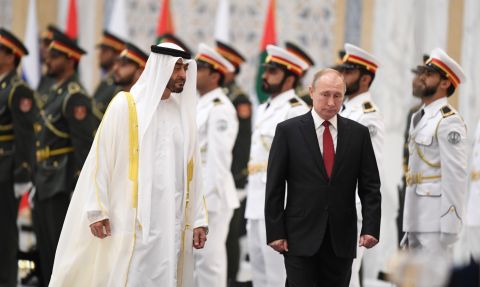
ALBAWABA- United Arab Emirates President Sheikh Mohamed bin Zayed Al Nahyan held talks with Russian President Vladimir Putin at the Kremlin on Thursday, focusing on expanding trade, economic cooperation, and investment, as broader geopolitical tensions weigh on regional and global stability.
Kremlin officials said discussions also covered international issues, including the war in Ukraine, instability in the Middle East, and rising tensions with Iran. Putin described the UAE as one of Russia’s key partners in the Arab world, citing steady growth in bilateral trade and joint projects.
Sheikh Mohamed arrived with a senior delegation that included ministers responsible for industry, trade, and investment, with talks also addressing energy cooperation and humanitarian efforts in Gaza.
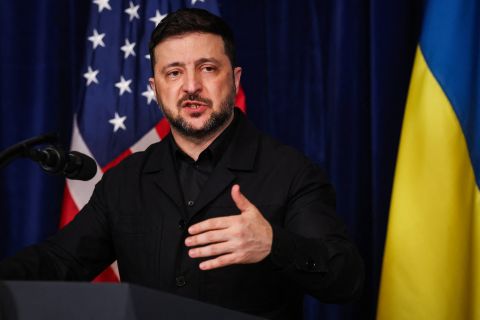
The visit follows closely on the conclusion of US-brokered trilateral talks involving Ukraine, Russia, and the United States, hosted by the UAE in Abu Dhabi on January 23–24. Ukrainian President Volodymyr Zelensky said the discussions were “constructive” and focused on parameters for ending the war, including security guarantees and territorial arrangements, with further rounds expected as early as next week.
Putin praised Abu Dhabi’s mediation role, noting its involvement in facilitating prisoner exchanges and maintaining communication channels between Moscow, Kyiv, and Washington, reinforcing the UAE’s growing profile as a neutral venue for high-level diplomacy.
The timing of the Moscow meeting also comes amid strained relations between the UAE and Saudi Arabia, with tensions surfacing across several regional arenas.
In Yemen, recent Saudi airstrikes on UAE-supplied arms destined for southern separatists highlighted disagreements over Abu Dhabi’s support for the Southern Transitional Council, which Riyadh views as a challenge to Yemeni unity and its own security interests.
Similar divergences have emerged in Sudan, Libya, and Somalia, prompting analysts to describe the relationship as an increasingly structural rivalry shaped by differing approaches to regional influence.
Adding to the backdrop is heightened confrontation between the United States, Israel, and Iran. Since Israeli strikes on Iranian nuclear facilities in June 2025 and subsequent US involvement, tensions have remained elevated, with Washington warning Tehran that nuclear negotiations are nearing a critical point.
Putin indicated that Iran would be among the key issues discussed with Sheikh Mohamed, reflecting Moscow’s close attention to Gulf stability and shared interests with the UAE in preventing further escalation.