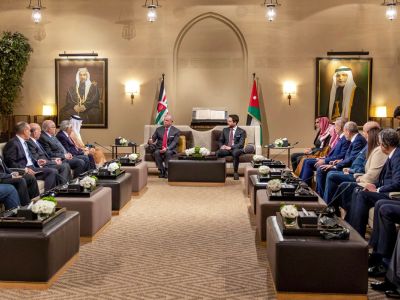
ALBAWABA- Arab and Muslim foreign ministers met in Jordan on Wednesday to coordinate a unified diplomatic response to what they described as escalating Israeli measures targeting Jerusalem's identity and its Islamic and Christian holy sites.
The meeting in Amman brought together members of the Arab Ministerial Committee on Jerusalem, Arab League Secretary-General Ahmed Aboul Gheit, and the foreign ministers of Türkiye, Saudi Arabia, Egypt, Pakistan, Indonesia and Malaysia. The talks focused on recent developments in occupied East Jerusalem and efforts to formulate a common position against Israeli policies in the city.
Jordanian Foreign Minister Ayman Safadi warned that Jerusalem faces "unprecedented danger," accusing Israel of intensifying settlement expansion, land confiscation, restrictions on Palestinians and attempts to isolate occupied East Jerusalem from the rest of the occupied Palestinian territories.
Safadi said Israel was pursuing policies aimed at altering the city's Arab, Islamic and Christian identity while undermining the historical and legal status quo at the Islamic and Christian holy sites, particularly Al-Aqsa Mosque. He also accused Israel of restricting freedom of worship and increasing pressure on Christian churches and clergy through extremist attacks and legislation targeting church-owned land and property.
He said the measures form part of a broader effort to consolidate Israel's occupation of the West Bank and weaken prospects for a two-state solution.
Egyptian Foreign Minister Badr Abdelatty reaffirmed Cairo's rejection of any attempt to change Jerusalem's Arab, Islamic and Christian character and reiterated Egypt's support for Jordan's Hashemite Custodianship over the city's holy sites. He also condemned Israeli settlement expansion and rejected any displacement of Palestinians from the Gaza Strip, the occupied West Bank or occupied East Jerusalem.
Saudi Foreign Minister Prince Faisal bin Farhan denounced continued Israeli actions in Gaza and the occupied Palestinian territories, describing settlement expansion and attempts to alter the status of Jerusalem's holy sites as illegal and without legal effect. He reaffirmed Saudi Arabia's position that occupied East Jerusalem is the capital of a future Palestinian state and urged the international community to take practical steps to halt Israeli violations and protect the city's religious sites.
Algerian Foreign Minister Ahmed Attaf warned against what he described as Israeli efforts to "Judaize" Jerusalem and erase its Arab, Islamic and Christian identity, calling for stronger Arab and international diplomatic coordination.
Tunisian Foreign Minister Mohamed Ali Nafti said preserving Jerusalem's identity and safeguarding its holy sites is a collective responsibility, reaffirming Tunisia's opposition to settlement expansion, forced displacement and any attempts to alter the city's historical, legal or demographic status.
Pakistani Foreign Minister Ishaq Dar condemned repeated incursions by Israeli settlers into Al-Aqsa Mosque, warning that such actions threaten the site's religious and historical status and risk widening regional tensions. He said all Israeli measures aimed at changing the character or legal status of occupied East Jerusalem are "null and void" and called on Arab and Muslim countries to strengthen diplomatic efforts, oppose settlement expansion and support implementation of the Gaza peace plan and UN Security Council Resolution 2803.
Iraqi Foreign Minister Fuad Hussein also condemned Israeli actions in Jerusalem, including settlement expansion, incursions into Al-Aqsa Mosque and the forced displacement of Palestinians, reaffirming Iraq's support for the establishment of an independent Palestinian state with occupied East Jerusalem as its capital.
The Arab Ministerial Committee includes Jordan, Saudi Arabia, Egypt, Iraq, Qatar, Morocco, Algeria, Tunisia and Somalia, alongside the Arab League secretary-general. Jordan hosted the meeting in its capacity as custodian of the Islamic and Christian holy sites in Jerusalem.