


Caught unprepared, the BJP government has looked woefully unequal to the task of handling a devastating second wave.
As India faces its worst-ever health calamity since independence in 1947, the nation is being subjected to an unforgiving reality check. The current wave of Covid-19 has all but dismantled tall notions of development and progress that many Indians had come to believe over the last seven decades.
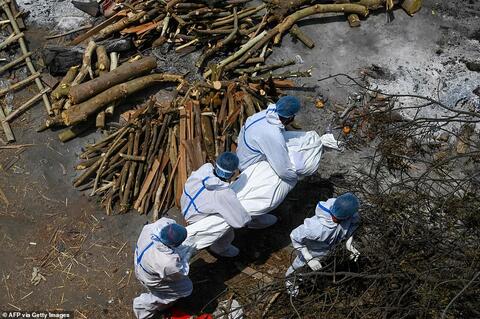
“We are just burning bodies as they arrive.”
— Al Jazeera English (@AJEnglish) April 26, 2021
India’s unfolding COVID crisis is most visceral in its overwhelmed crematoriums and graveyards — in pictures https://t.co/zAnO9wPl1y pic.twitter.com/XCOTAH0Wh6
By February this year, many Indians believed the pandemic was behind them as the caseload was at its lowest ebb since the peak in September 2020. For example, on September 16, the number of new cases stood at 97,894 while on February 8 this year, new cases were a mere 9,110.
India's hospitals are full and oxygen supplies are running out. Here's how you can help. https://t.co/zHzZwK4RRw
— New York Times World (@nytimesworld) April 28, 2021
The federal government, and various state governments too, were lulled into a false sense of comfort resulting in corona-related health infrastructure – painstakingly built in previous months – being dismantled.
This report by the BBC on India's Covid-19 crisis will shake you to the core. Incredibly disturbing.
— Saket Gokhale (@SaketGokhale) April 22, 2021
The Modi govt literally has the blood of innocents on its hands, and yet, all they're still doing is filthy politics instead of taking responsibility.
pic.twitter.com/brdTLthVa5
An 800-bed hospital in the western Indian city of Pune reportedly shut down in January only to be hurriedly restarted a couple of months later when cases shot up. Authorities in north India's Uttar Pradesh, the country's largest state, had claimed it had set up over 800 hospitals with 100,500 beds. But, in February, reports showed there were just about 80 hospitals with 17,000 beds.
There was a sense of accomplishment pervading within Prime Minister Narendra Modi's government and preening that India had managed to control the pandemic. In June last year, Modi was quoted by the Hindustan Times daily as saying that the nation “was able to tackle Covid-19 far better than experts around the world had believed it could because of the timely country-wide lockdown, which gave it time to ramp up its health system significantly.”
Even health workers – including doctors, nursing staff and hospital management – were smug in the belief that the pandemic was behind them. Therefore, when India’s vaccination drive started on January 16 this year, the response was tepid. According to reports, by the time the special window for health workers closed, less than half of the estimated 30 million health workers had taken two doses of the vaccine.
Devastating images of patients dying for lack of oxygen. India has failed its people like never before. My latest report for Time magazine on Narendra Modi's criminal abdication of responsibility in dealing with the second deadly Covid wave in India. https://t.co/gmZ49s9iSz
— Rana Ayyub (@RanaAyyub) April 23, 2021
While some in the medical community argued that there was no reason to get vaccinated as cases were dipping, others were reluctant on various grounds including the notion that the vaccines had been made in a hurry and there were questions regarding their efficacy and safety. As a result, the special vaccination window for health workers turned out to be a damp squib.
That was the mindset in January and February when case numbers started to creep up, initially disregarded and then noted with some concern. Finally, when cases jumped exponentially, the government and the public were caught completely unprepared – landing right in the middle of a giant Covid-19 wave that has since rudely rocked Indians, as the rest of the world views it with horror.
India's Covid-19 crisis is a problem for the world | Analysis by @AditiSangal https://t.co/sBX2KP1qXR pic.twitter.com/NHNGRZ0OIv
— CNN International (@cnni) April 29, 2021
As of now, the number of cases has spiralled to 17.3 million with a jump of 352,991 on a single day alone on April 25. Of these, 14.3 million overall have recovered and 195,000 have died.
Anecdotally, compared to Covid 1.0, the second wave has affected far more of my friends, close relatives, colleagues and acquaintances with accompanying tragedies of varying degrees. Though in the midst of the second wave, notwithstanding the numerical count, it is becoming difficult even to comprehend the scale and intensity of the pandemic in the various ways it is affecting India’s mammoth population.
As this is being written, the cases are still on an upward trajectory across the nation except in the commercial hub of Mumbai where numbers are dropping steadily over the last five days suggesting that the city peaked the earliest.
India's COVID-19 crisis is spiraling out of control. It didn't have to be this way https://t.co/jMaL7wZSx7 pic.twitter.com/QA9FCsH6Qp
— TIME (@TIME) April 29, 2021
As for the national capital Delhi and its suburbs, an absence of oxygen supplies and a shortage of ICU beds are nothing short of a nightmare. The abysmal state of health infrastructure has not spared even an otherwise well-endowed city like the nation’s capital, where the country’s ruling elite including President Ram Nath Kovind, Prime Minister Modi and the entire state apparatus are all located.
Unsurprisingly, the rest of the country is also suffering from the same severe shortages. Reports have spotlighted how many patients have died because they were not given oxygen on time, or there was lack of hospital beds and ICU treatment, and even the non-availability of ambulances.
""There is even no respect for the dead anymore. There is only fear" - My Interview with the Belgian (Flemish) Daily Newspaper, De Standaard on India's worsening Covid crisis. https://t.co/tncP0y6vPo via @destandaard
— Ashok Swain (@ashoswai) April 29, 2021
A government not interested in governance
In all this, the Hindu nationalist government of the Bharatiya Janata Party (BJP) has come out looking inept and woefully unequal to the task of governance, contrary to all the tall promises dished out in various election rallies right from 2014, when Modi came to power on the plank of “development” and won a second term in 2019 on the issue of “national security” with an even bigger majority.
The rising levels of criticism on social media, unprecedented in the last seven years, has even led the government to pressure Twitter, Facebook and Instagram to remove tweets and posts that attempt to “expose” the government’s inefficiency. Reports said some 150 tweets have already been pulled off social media platforms at the insistence of the government, on grounds of alleged “misinformation”.
Modi slammed on social media amid deadly COVID-19 surge in India
— DIC (@Conspiratorfeku) April 20, 2021
Tags including #ResignModi #SuperSpreaderModi have trended on Twitter in th past 2days,as desperate cries for hospital beds, medical oxygen &coronavirus tests flooded social mediahttps://t.co/ueyj6KWEgU @AJEnglish
The desperate official response to the pandemic has increasingly led to a view that government ministers led by Modi and his associate, Home Minister Amit Shah, are more interested in winning elections than they are in governance. When numbers started to rise in February, the BJP were singularly focused on planning election strategies in a few states.
The eastern state of West Bengal in particular was in the crosshairs of the BJP campaign with almost the entire ministry led by Modi and Shah focusing all their energies on this politically crucial state.
#Watch | Congress leader @PriyankaGandhi slammed PM Modi for holding poll rallies amid rising #Covid19 cases. Priyanka said the government is not doing enough to boost medical infrastructure.
— Hindustan Times (@htTweets) April 21, 2021
She also criticised the UP govt for failing to increase the number of Covid tests. pic.twitter.com/To8dSKV4BN
As the numbers continued to rise, doctors started to warn of an impending second wave with forceful pleas to reduce crowding, maintain social distancing and wear masks. But the pleas fell on deaf ears with political parties, including the BJP – and the regional biggie, the Trinamool Congress, led by Bengali satrap Mamata Banerjee – assembling crowds by the thousands for political rallies and election meetings.
The other goof up was the decision to allow a gathering of around 3.5 million pilgrims at the Hindu religious event Kumbh Mela in the northern Indian town of Haridwar that takes place once every 12 years. The event is spread out over a few weeks and was scheduled to climax on April 27, when five million pilgrims were supposed to gather.
The huge gathering was allowed to take place until just a few days ago when the government finally decided to scale it down drastically following the death of prominent religious leader Mahamandaleshwar Kapil Dev Das, due to the coronavirus.
Didi slammed the central government for the negligence on corona
— Salman Shaikh (@SalmanS97285684) April 24, 2021
She called the covid situation a 'Modi made disaster'. But when it comes to saving the people, Didi won't stop. She will take all necessary steps to make the situation better in Bengal#BanglarGorboMamata pic.twitter.com/FDnAVCr80c
But the damage had already been done, with media reports stating as early as April 1 that some 5,037 pilgrims were Covid-19 positive. Besides this, some 65 health workers who were monitoring pilgrims were also infected.
Worse, pilgrims from innumerable parts of the country would have returned to their homes with many more possibly carrying the virus.
The University of Washington’s Institute for Health Metrics and Evaluation (IHME) in a study has said the Indian peak could occur around mid-May when daily deaths could be in the range of 5,600. If this turns out to be true, it would mean that the crisis is far from over.

Whatever India is experiencing now is probably only the initial stirrings of a wider disaster. The only hope right now is that, like in 2020 when there was a similar prediction, there is an inexplicable fall in cases.
This article has been adapted from its original source.



