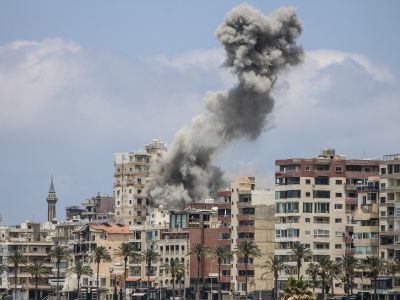
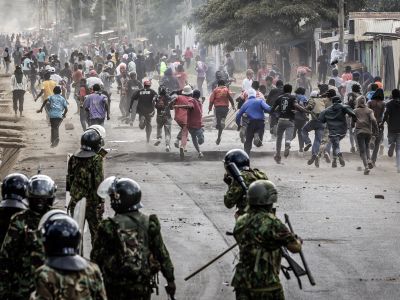
While most Arab markets ended the week on a positive note, the Palestinian bourse plunged for the second week in a row due to the ongoing conflict with Israel.
The Jerusalem index of the Palestinian territories ended 4.3 percent lower, in addition to last week’s 4.8 percent drop, as it closed the week at 149.15 points. In Lebanon, the BLOM index also fell 4.2 percent to 444.53 points, due to the drop in market-leader Solidere, the private real estate company in charge of Beirut’s post-war reconstruction.
In Egypt, following last week’s tumble to its lowest level in seven years, the Hermes Finacial Index gained back losses as it rose 4.7 percent to close the week at 5,532.97 points. Gains were attributed to strong performances by Egyptian Media Production City and Commercial International Bank.
The Saudi Arabian market, with the highest capitalization in the Arab world, climbed 1.3 percent to its highest level since 1985, reaching 2,528.65 points. The recent steady gains are the result of rising oil prices and a strong performance by the petrochemical giant SABIC.
In Oman, the MSM index rose an impressive 2.3 percent to 176.02 points, whereas Bahrain’s BSE index ended two percent higher at 1,747.84 points. Both bourses attributed the rise to gains in the banking sector.
Kuwait’s KSE index and UAE’s NBAD index inched up 0.3 percent and 0.2 percent, to end the week at 1,699.70 and 2,430.70 points, respectively. The Jordanian bourse rose 0.6 percent to 145.01 points, whereas Qatar’s CBQ index rose 0.5 percent to 247.9 points.
In the African continent, Morocco’s CSE index gained a solid 2.8 percent reaching 635.20 points, due to an announcement of anticipated upcoming market reforms. The Tunindex in Tunisia rose a mere 0.1 percent to 1,325.26 points. — (Mena Report)
© 2001 Mena Report (www.menareport.com)