


ALBAWABA — Talks inside the White House have come up with a politically smart way to deal with Iran: Israel attacks first, and the US joins the fight later to protect its ally.
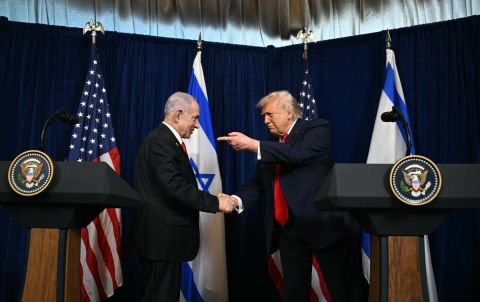
Politico, which Al-Ain News cites, says that senior advisers to President Donald Trump think that the political optics would be much better if Israel attacked Iran first, which would lead to retaliation that would make American involvement seem more defensive than preemptive.
Political Decisions vs. Military Needs
People who know what's going on inside say that the main concern is less about whether the military can do it and more about how it will look politically at home. Recent polls show that a large number of Americans, especially Republican voters, want regime change in Iran but are still worried about U.S. casualties.
Officials are said to have said that an Israeli first strike could make it easier to frame U.S. actions after that as a response to Iranian aggression instead of the start of a new Middle East war.
Still, analysts wonder if President Trump really needs such a reason. In the past, Washington has always been able to find a reason to use military force when it is in its best interest. Trump has shown that he is willing to change stories forcefully, which makes people wonder if "justification" is a real limit or just part of the larger political dance.
Geneva is where diplomacy happens, but there is pressure in the background.
Steve Witkoff and Jared Kushner are still working on diplomacy in Geneva, but hopes for a breakthrough seem to be fading. Marco Rubio, the Secretary of State, recently called Iran's refusal to talk about its ballistic missile program a "major problem." This shows that Washington sees the nuclear issue as only one part of the puzzle.
Trump talks a lot about wanting to use diplomacy, but people close to him say that military planning is still very much on his mind.
The Range of a Possible Strike
Reports say that the options range from a small strike meant to force Tehran back to the table for talks to a larger campaign against nuclear facilities and missile launch sites. There have also been talks about more extreme scenarios, like a "decapitation strike" against Supreme Leader Ali Khamenei. However, officials say that Iran's system does not depend on one person and that retaliation could be very bad.
Risks of escalation and going too far in strategy
One of the administration's biggest worries is running out of ammunition and going too far with its plans. The U.S. military is building up in the area right now. This is the biggest buildup since the 2003 invasion of Iraq. It includes two carrier strike groups and dozens of combat planes.
The U.S. might not be as ready for other threats if it has to deal with Iran for a long time, especially since tensions with China are rising over Taiwan.
Intelligence officials have warned that Iran may retaliate in an uneven way against American personnel and facilities in the Middle East and Europe. This would make any long-term conflict more expensive politically.
Congress Split, Claims Under Fire
House Armed Services Committee Chairman Mike Rogers says that there is "clear" evidence that Iran is trying to bring parts of its nuclear program back to life on Capitol Hill. However, some Democrats report not receiving similar briefings, reflecting partisan divisions.
Last year, Trump said that U.S. strikes "obliterated" Iran's nuclear program, but he has recently said he is not sure if Tehran gave up its plans.
Iran, on the other hand, says its nuclear activities are peaceful. Washington, on the other hand, continues to question this, especially since uranium enrichment levels are so high.
Negotiation Strategy or Road to War?
Some people think that the Israeli-first scenario is part of a bigger negotiation strategy, like "bad cop, good cop" in geopolitics. Benjamin Netanyahu, the Prime Minister of Israel, puts pressure on the situation and makes it worse, while U.S. diplomats keep talking.
But from Iran's point of view, the difference might not matter. It doesn't matter if an F-35 jet has an American or Israeli flag on it; it is still made in the U.S. Either way could mean the end of diplomacy and the start of open war.
Insiders say that in the end, any decision will not be based only on military factors. It will be a balancing act to figure out the political costs, strategic risks, alliance dynamics, and domestic pressure.